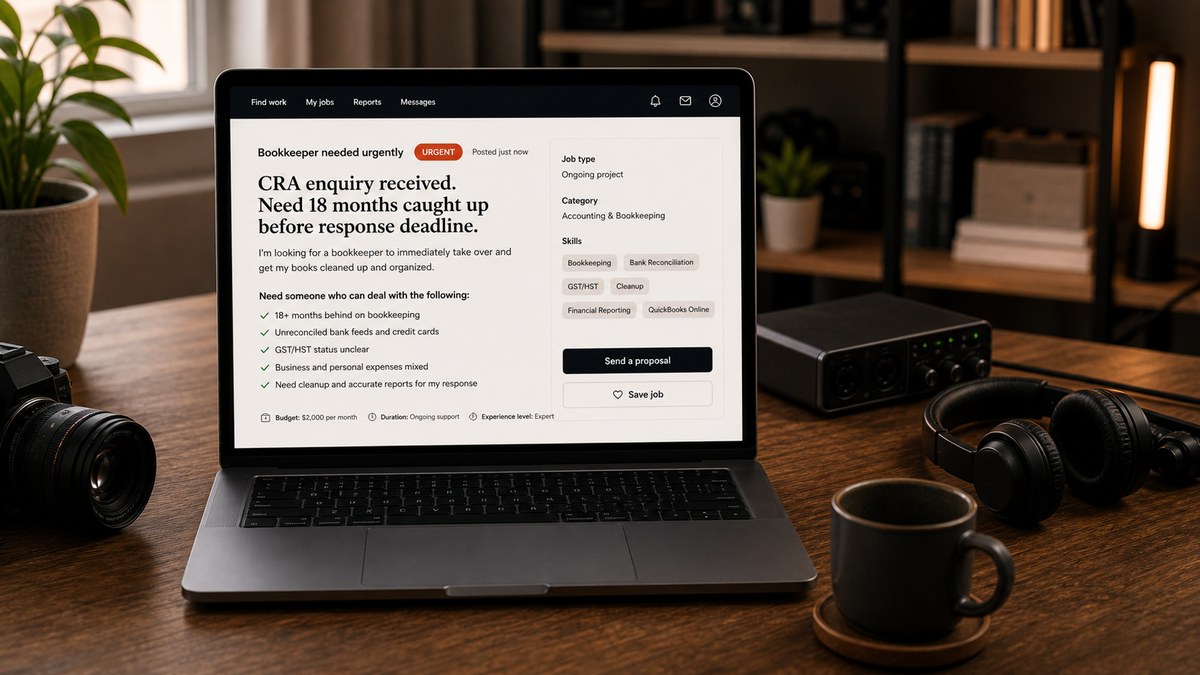
When you start something new, the books are not where you want to spend your attention. There is an offering to build, clients to find, and a hundred things that feel more urgent than deciding where to keep your receipts. So you start piling things up with a promise of someday, and the business moves on.
But this is exactly where things start to go wrong: with a few small things left untouched at the beginning, repeated over time.
The best possible time to set the books up correctly is before there’s anything to clean. It will just keep getting more expensive the longer you wait, and it compounds fast.
Here’s a few things you can do now to save yourself a lot of pain down the line.
Separate the money first
Open a dedicated business bank account and get a card that is only for the business. A sole proprietor can still open a business account, so it doesn’t matter if you’re not incorporated. At the very least, use a separate personal account for business activity and keep your personal spending entirely out.
This is possibly the single most valuable thing a new founder can do, and it costs almost nothing. When business and personal money share an account, every later attempt to understand the business means untangling the two by hand, transaction by transaction, often a year after you’ve forgotten what half of them were. When they are separate from day one, the business account becomes the record.
Keep everything, in one place
The CRA expects you to hold onto your records for six years. You don’t need a filing cabinet; digital copies are fine. What you need is one place where receipts and invoices go, decided now and used every time, so that the documentation exists when you eventually need it and isn’t being reconstructed from memory and bank statements under pressure.
The habit matters a lot more than the tool. A simple system you keep up beats a sophisticated one you abandon.
Watch the line before you reach it
For most businesses in Canada, there is a $30,000 GST/HST small-supplier threshold to watch. Once your worldwide taxable supplies pass that line, you are usually going to have to register and start charging GST/HST.
Track your revenue from the very first dollar so that crossing the line is something you see coming, not something you discover months after the fact. Founders who do not track it get to find out the hard way, and the hard way has interest attached.
Set money aside as it comes in
Income that lands in your account is not all yours. Some of it belongs to taxes, some came from the GST/HST you have collected on the government’s behalf, and some of it needs to cover prior expenses that have not yet been settled.
The discipline that saves new founders the most grief is the simplest one: move a portion aside as money comes in, so the obligations are already covered when due and you’re never funding old expenses with new work.
Why I Built Founders First
None of this is complicated. The setup is not hard work. It is just easy to skip, and skipping does not hurt at all until time passes, when a small business that should be simple to read has become a knot that takes real effort to undo.
Set it up properly once and the books are not hard to maintain. Set it up loosely and you’ve signed up for a cleanup you don’t yet know is coming.
This is why I made the Founders First program for entrepreneurs at the very beginning: getting the books, the systems, and the habits right from day one, for solo founders just getting off the ground. The best time to build a clean foundation is before there’s anything sitting on top of it. The second-best time is now.